Edo State Development Pillar

Education, Technical, Vocational & Secondary

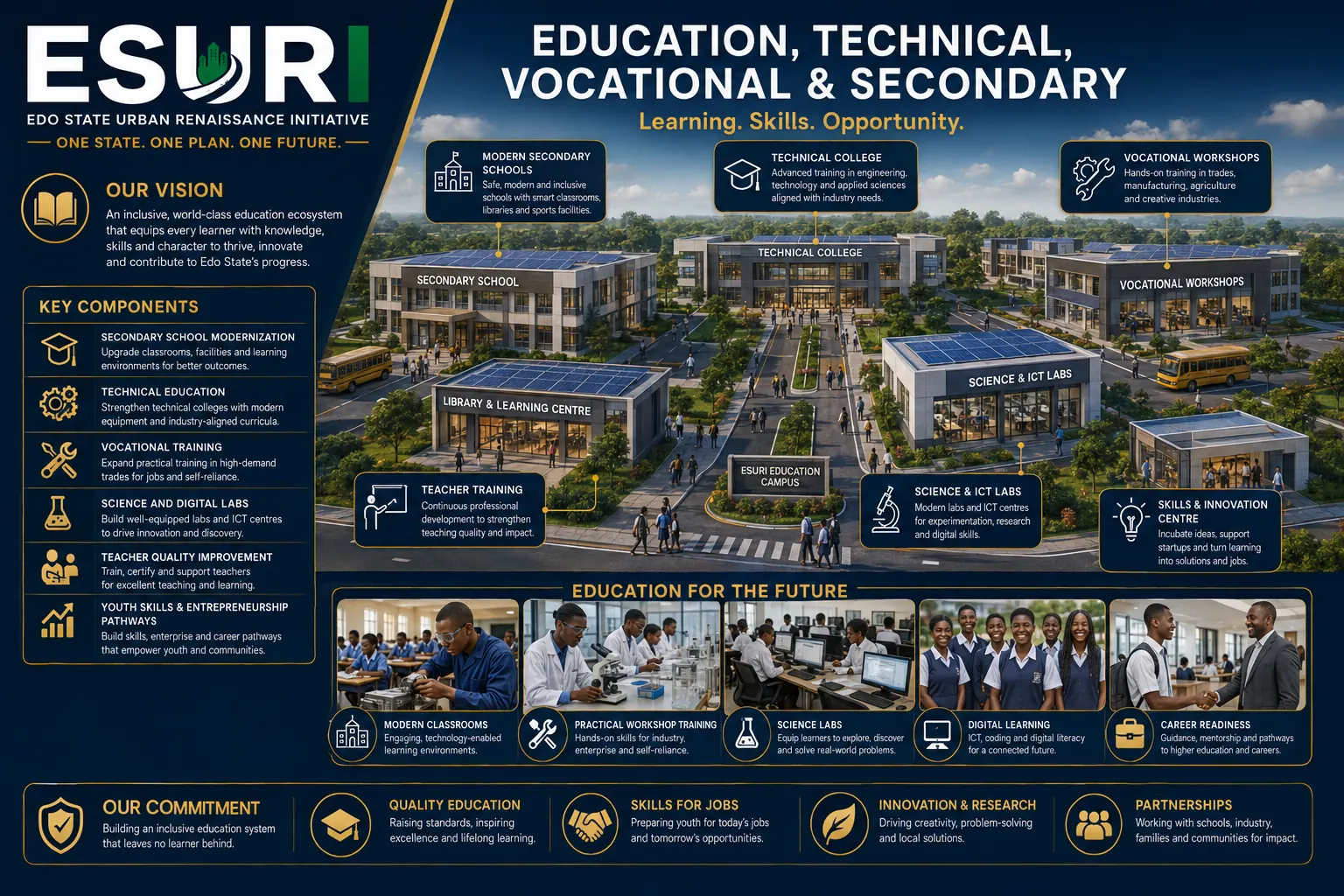
Education is the youth engine of ESURI: free education from 0–18, modern secondary schools, technical colleges, vocational pathways and university education supported through a structured student-loan system.

Back to 8 PillarsBlueprint PDF
Education, Technical, Vocational & Secondary
Why this matters

Advantages

  • Makes education free from 0–18 so every child can move from early learning through secondary education without school fees blocking their future.
  • Gives young people practical skills, not just certificates.
  • Connects education to construction, energy, healthcare, ICT, transport, agriculture and industry.
  • Creates apprenticeship routes inside Edo State projects.
  • Supports entrepreneurship, digital literacy and career readiness.
  • Funds university education through a structured loan system that allows students to study first and repay later when earning.
Delivery profile

Cost, funding and jobs

These are planning estimates for discussion. Final figures require feasibility studies, engineering designs, procurement review and financial modelling.

Funding route

Mixed funding: public budget, partnerships, project vehicles and private participation where appropriate.

Job prospects

10,000 – 18,000 direct education-sector jobs, plus far larger youth employment pathways through apprenticeships and skills linked to all ESURI projects.

Delivery principle

Deliver in phases, publish milestones, and connect local skills to project work.

How it will be funded

  • State education budget to guarantee free education from 0–18.
  • Universal Basic Education support where applicable.
  • A structured Edo student-loan system for university education, with repayment linked to future earnings.
  • Skills partnerships with contractors, industries and technical institutions.
  • Donor and diaspora support for labs, libraries, ICT, scholarships and vocational equipment.
  • Public-private partnerships for innovation hubs, technical colleges and vocational centres.
Free education and student loans

Education as the youth engine

ESURI’s education policy is to make education free from 0–18, covering early years, primary and secondary education. This gives every child a fair start and removes the fear that poverty will push children out of school.

For university education, ESURI should use a structured student-loan model. Students should be able to access higher education first, then repay gradually after graduation when they are working. This protects opportunity while keeping the system financially sustainable.

Technical, vocational and secondary education will be directly linked to the jobs created by the wider Edo State development programme.